Ball joint
A ball joint is the pivoting ball-and-socket joint connecting the control arm to the steering knuckle, letting the wheel both steer and travel over bumps.

What it means
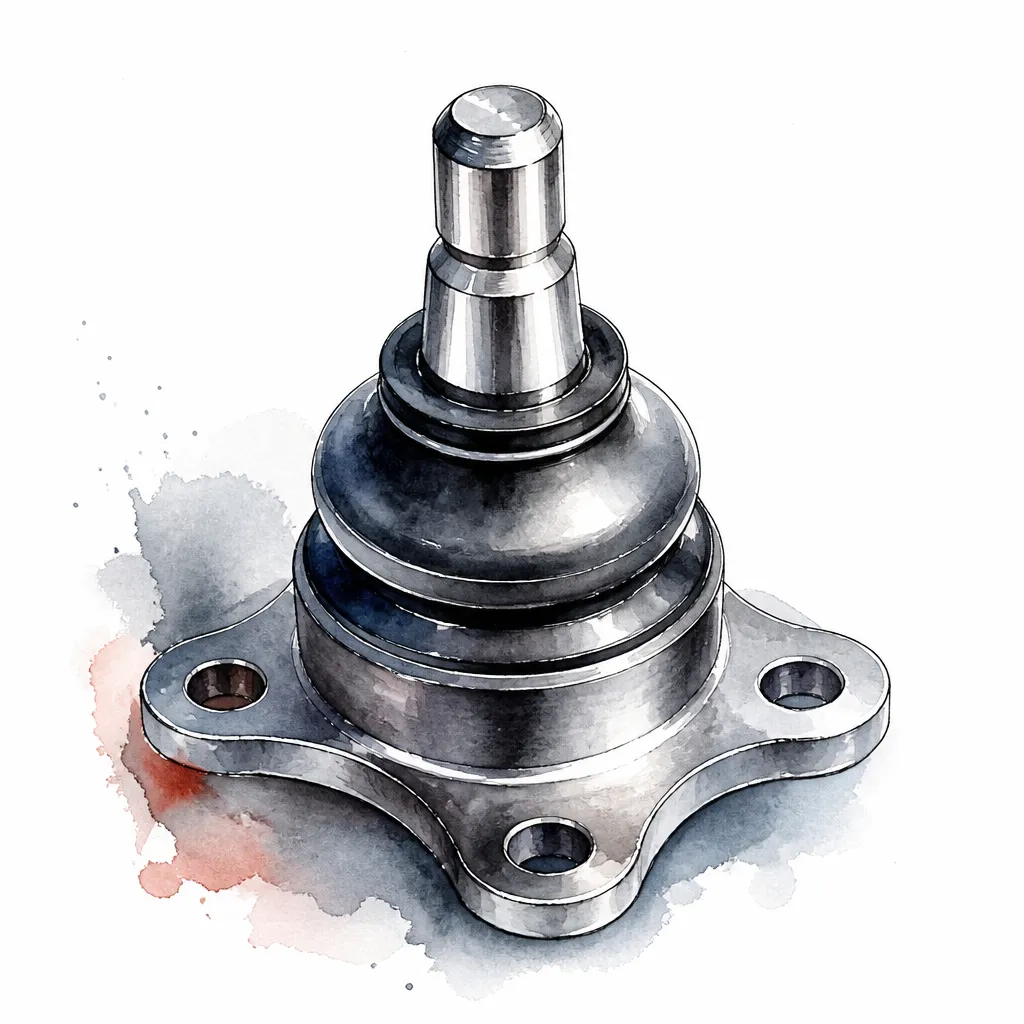
A ball joint works like the joint in a human hip: a hardened steel ball sits inside a lubricated socket, free to rotate and pivot in several directions at once. It sits between the control arm and the steering knuckle, so it has to carry the weight of the corner of the car while still allowing the wheel to swivel left and right for steering and move up and down over the road. Most cars have a lower ball joint on each side, and many have upper ones too. The ball joint is sealed with a rubber boot that keeps grease in and dirt and water out. When that boot splits, grease escapes, contaminants get in, and the joint starts to wear. A worn ball joint shows up as knocking or clunking over bumps, vague steering, uneven tyre wear, or movement felt when the wheel is rocked by hand. A ball joint is a wear item, not a lifetime part, and a badly worn one can in the worst case separate and cause the wheel to collapse.
Why it matters in Singapore
Singapore's tropical heat hardens and cracks the rubber boots that protect ball joints, and the constant stop-start of city driving keeps the joints working under load. Speed humps, kerbs, and the occasional pothole add sharp shock loads. Because most cars here run for the full ten-year COE life, ball joints often reach a stage of wear that an inspection will flag, so catching a torn boot early is far cheaper than replacing a failed joint.

How Revol Carz handles this
Revol Carz Garage inspects ball joints during routine servicing on BMW, Mercedes, Audi, and Volkswagen, checking each boot for splits and rocking the wheel to feel for play. When a joint is worn we replace it with OEM-grade parts and follow up with a wheel alignment, since steering geometry shifts once a joint is changed.