

The sudden sound of impact, the jolt of the collision-it’s a moment no driver wants to experience. In the immediate aftermath, a wave of stress and uncertainty can be overwhelming. What are the correct first steps? Who should you contact? How do you properly document the scene to ensure a smooth car insurance claim process? Making a mistake in these critical moments can feel like a costly risk, adding to an already difficult situation.
As Singapore’s trusted automotive care specialists, we understand the anxiety that follows an accident. That’s why we’ve created this comprehensive, step-by-step guide. We will walk you through everything you need to know, from managing the accident scene with confidence to navigating the paperwork and selecting a workshop that will meticulously restore your vehicle. Our goal is simple: to transform a confusing and stressful process into a clear, manageable, and hassle-free experience, getting you and your car back on the road in pristine, showroom condition.
What to Do Immediately After a Car Accident in Singapore
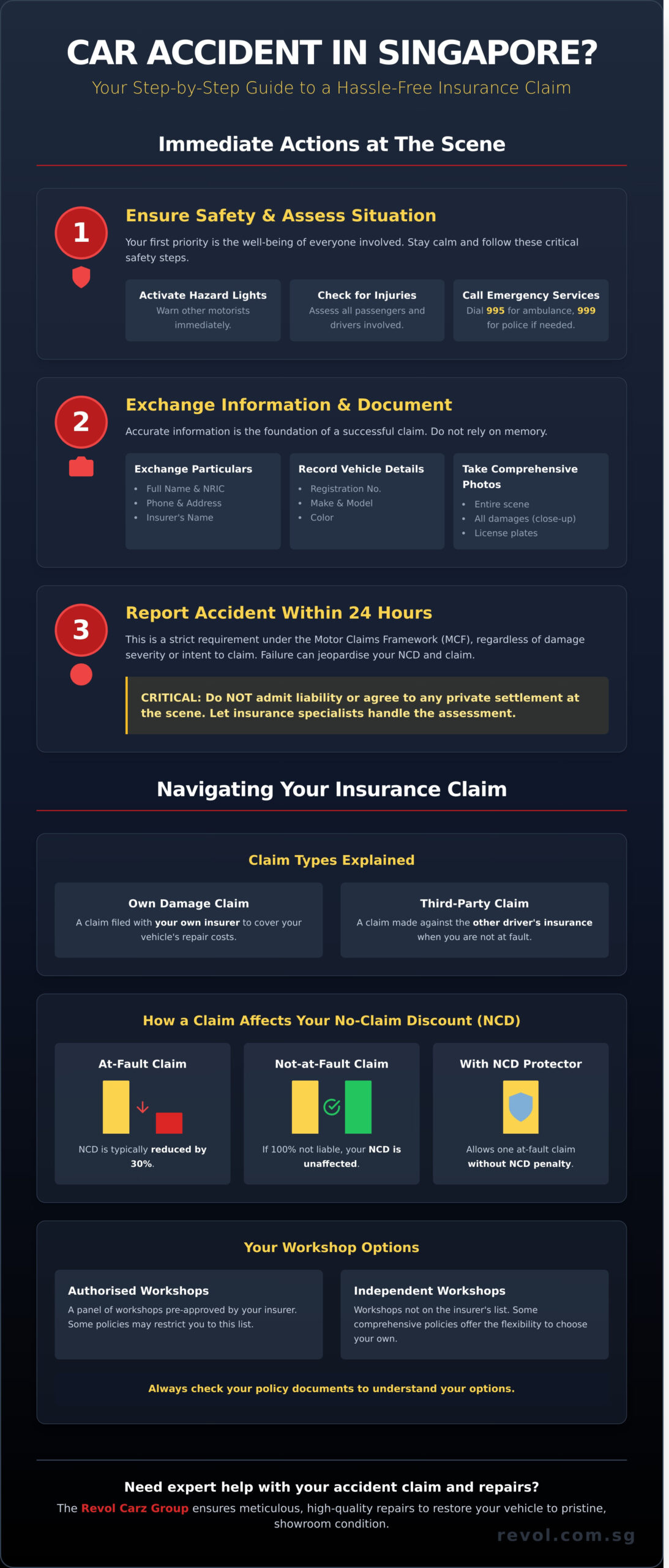
In the stressful moments following a car accident, your immediate actions can significantly impact the entire process of your car insurance claim. Staying calm and following a clear, methodical procedure is crucial. Having comprehensive vehicle insurance is your safety net, but knowing the correct on-the-spot protocol ensures a smooth, hassle-free resolution. Your first priority is always safety, followed by meticulous information gathering and prompt reporting. Do not move your vehicle unless it poses a severe safety hazard or you are instructed to do so by a police officer.
Step 1: Ensure Safety and Assess the Situation
Your immediate priority is the well-being of everyone involved. Before exiting your vehicle, take a moment to compose yourself and then follow these essential safety steps:
- Activate Hazard Lights: Immediately switch on your car’s hazard lights to warn other motorists.
- Check for Injuries: Assess yourself and your passengers for any injuries. Then, if it is safe to do so, check on the driver and passengers of the other vehicle(s).
- Call for Emergency Services: If anyone is injured, call 995 for an ambulance without delay. If the accident involves injuries, obstructs traffic, or includes a non-Singapore registered vehicle, you must also call the police at 999.
Step 2: Exchange Information and Document Everything
Gathering accurate information is the foundation of a successful insurance claim. Do not rely on memory. Meticulously document every detail while at the scene.
- Exchange Particulars: Politely exchange the following with the other driver(s): Full Name, NRIC number, Phone Number, Home Address, and the name of their Insurance Company.
- Record Vehicle Details: Note down the vehicle registration number, make, and model of all cars involved in the accident.
- Take Comprehensive Photos: Use your phone to take clear pictures of the entire accident scene from various angles, showing the positions of the vehicles. Capture close-up shots of all damages to every vehicle, including the license plates. This visual evidence is invaluable.
Step 3: Report the Accident Within 24 Hours
Prompt reporting is not just a recommendation; it is a strict requirement in Singapore. Failing to do so can have serious consequences for your claim and policy.
Under the Motor Claims Framework (MCF), you must report any accident to your insurer within 24 hours, regardless of whether you intend to claim or how minor the damage appears. Failure to report in time can jeopardise your No-Claim Discount (NCD) and may lead to your insurer refusing to cover your claim. Crucially, do not admit liability or agree to any private settlement at the scene. Let the insurance specialists handle the assessment and negotiation process.
Understanding the Singapore Motor Claims Framework (MCF)
After an accident, the path to resolution can seem complex. Fortunately, Singapore has a standardised procedure designed to make the process clear and efficient for all drivers. The General Insurance Association (GIA) of Singapore established the Motor Claims Framework (MCF) to provide a clear, common procedure for motor accident reporting. Understanding this framework is crucial, as it outlines your rights and obligations, ensuring a smoother and more predictable car insurance claim experience. It also clarifies the important distinction between simply reporting an incident for record-keeping and actively filing a claim for damages.
Own Damage vs. Third-Party Claims
When you need to make a claim, you generally have two primary options. An Own Damage Claim is filed with your own insurer to cover the repair costs for your vehicle. A Third-Party Claim is made against the other driver’s insurance policy when you are not at fault for the accident. Deciding which route to take depends on the specifics of the incident. A trusted and experienced workshop specialist can assess the situation and provide professional advice on the most appropriate and cost-effective type of claim to file.
How a Car Insurance Claim Affects Your No-Claim Discount (NCD)
Your No-Claim Discount (NCD) is a significant saving on your insurance premium, awarded for each year you drive without making a claim. Filing a claim can impact this discount, but not always. Here’s what you need to know:
- At-Fault Claims: If you are found to be at fault, making a claim will typically result in a reduction of your NCD, usually by 30%.
- Not-at-Fault Claims: If the other party is found to be 100% liable for the accident, your NCD will not be affected.
- NCD Protector: Many insurers offer an NCD protector as an optional add-on. For a small additional premium, this allows you to make one at-fault claim within a policy year without losing your NCD.
The Role of Authorised Workshops and Independent Workshops
Your insurance policy will specify where you can get your vehicle repaired. Authorised workshops are on a pre-approved list provided by your insurer. In contrast, independent workshops are not on this list. Some comprehensive policies offer the flexibility to choose your own workshop, while others may restrict you to their authorised panel. It is essential to review your policy documents to understand your options. Ultimately, choosing a reliable specialist workshop ensures that your vehicle receives meticulous, high-quality repairs that restore its safety and pristine condition.
Filing Your Claim: A Step-by-Step Walkthrough
Once you have safely documented the accident scene, the formal process of filing your car insurance claim begins. This procedure is designed to be systematic and transparent, ensuring all damages are properly assessed and rectified. In Singapore, these steps are guided by the official Motor Claims Framework, which provides a clear structure for motorists and insurers. Following this process meticulously is key to a smooth and successful outcome.
Reporting the Accident and Submitting Documents
Your first official action is to report the incident within 24 hours. You can do this at your insurer’s approved reporting centre or directly at a trusted, claims-specialised workshop like Revol Carz Group. It is crucial to bring all necessary documents to ensure a swift process. Be prepared to submit:
- Your original Driving License and NRIC (or FIN for foreign drivers)
- The Certificate of Insurance for your vehicle
- All photos and videos you captured at the accident scene
- Any saved in-car camera (dashcam) footage of the incident
Providing a comprehensive set of documents and evidence from the outset helps prevent delays and supports a straightforward claim.
The Damage Assessment and Survey Process
After you have filed the report, your insurance company will appoint a surveyor to conduct a detailed damage assessment. The surveyor’s role is to inspect your vehicle and verify that the damages are consistent with the accident report. They will then authorise the necessary repair work and associated costs. A distinguished workshop will manage this crucial stage for you, liaising directly with the surveyor to ensure a fair and comprehensive assessment, providing you with a truly hassle-free experience.
Repair Authorisation and Completion
Once the surveyor provides approval, the workshop receives the green light to commence with the restoration of your vehicle. This is a comprehensive process that includes meticulous bodywork, essential mechanical checks, and a flawless finish with professional spray painting to restore its showroom-shine condition. Throughout the repair journey, you will be kept informed of the progress. Upon completion, you will inspect the vehicle and sign a satisfaction form, confirming that the work has been completed to the highest standard.
Choosing the Right Workshop for Accident Repairs
After an accident, the choice of a repair workshop is one of the most critical decisions you will make. The quality of workmanship directly impacts your vehicle’s safety, performance, and long-term value. A distinguished workshop does more than just fix visible damage; they meticulously restore your car to its pre-accident condition and expertly manage the entire car insurance claim process on your behalf, providing you with complete peace of mind.
Why a Specialist Workshop Matters
For modern vehicles, especially premium European marques, a specialist workshop is invaluable. These facilities possess brand-specific diagnostic equipment and state-of-the-art tools required for complex repairs. Their technicians receive continuous training on the latest vehicle technologies and repair protocols. Furthermore, they prioritise the use of genuine parts, ensuring a perfect fit and preserving your car’s warranty and integrity. For instance, a workshop that is a trusted specialist for brands like BMW and Mercedes-Benz offers an unparalleled level of expertise.
What to Look For in a Repair Workshop
To ensure you receive the highest standard of service, look for a workshop with a proven track record. Key indicators of a reliable and professional operation include:
- Verifiable Customer Reviews: Check for a substantial history of positive, 5-star reviews on trusted platforms like Google and SGCarMart.
- Workmanship Warranty: A confident workshop will always provide a warranty on their repair and paintwork, standing behind the quality of their service.
- Insurance Claim Experience: Ensure they have comprehensive experience in handling claims with all major Singaporean insurers.
- Transparency and Communication: They should provide clear explanations, detailed quotations, and regular updates throughout the repair process.
How a Workshop Can Assist with Your Claim
A top-tier workshop acts as your dedicated partner, transforming a potentially stressful situation into a smooth, hassle-free experience. Their team manages the intricate details of your car insurance claim, allowing you to focus on your daily life. This expert assistance typically includes handling all communication with the insurance surveyor to get repair approvals, ensuring all necessary work is completed to the highest standard, and even providing a courtesy car to minimise disruption. This comprehensive support is the hallmark of a truly customer-focused service.
For professional accident repairs and seamless claims assistance in Singapore, contact the specialists at Revol Carz for an obligation-free consultation.
Common Pitfalls to Avoid During Your Car Insurance Claim
Navigating the aftermath of a car accident is stressful enough without making errors that could complicate or even jeopardise your car insurance claim. Understanding these common pitfalls is the first step toward protecting your financial interests and ensuring a smooth, successful resolution. To safeguard your policy and entitlements, it is essential to prioritise official procedures over informal roadside agreements.
By remaining informed and cautious, you can confidently manage the process and avoid costly mistakes.
Mistake 1: Admitting Fault at the Scene
In the immediate shock of an accident, it is crucial to avoid admitting liability, even if you believe you are responsible. Statements such as “I’m so sorry, it was my fault” can be used against you during the claims process. Instead, focus on exchanging details and documenting the scene. Allow your insurer and the relevant authorities to meticulously assess all evidence and officially determine liability.
Mistake 2: Making a Private Settlement Without Reporting
While settling minor damages privately to protect your No-Claim Discount (NCD) might seem appealing, failing to report the accident is a critical mistake. Most insurance policies in Singapore mandate that you report any accident within 24 hours, regardless of the severity. Neglecting this duty can breach your policy terms, potentially voiding your coverage and leading to complications if the other party files a claim later.
Mistake 3: Using Unauthorised Tow Trucks or Repair Shops
After an accident, be wary of unsolicited tow services that arrive at the scene. These operators may pressure you, inflate costs, or take your vehicle to an unapproved workshop. Your first call should always be to your insurer’s dedicated hotline for an authorised tow truck. Using a repair shop that is not on your insurer’s approved list can invalidate your entire car insurance claim and may result in substandard repairs. For complete peace of mind, always partner with authorised specialists who have a proven track record and outstanding customer reviews.
For a hassle-free claims process and expert, authorised repairs, trust the specialists at Revol Carz. We are committed to restoring your vehicle to its pristine, pre-accident condition. Visit us at revol.com.sg to learn more about our comprehensive accident and repair services.
Navigate Your Car Insurance Claim with Confidence
The process of filing a car insurance claim in Singapore can feel complex, but it doesn’t have to be. By remembering the critical first steps at the accident scene and understanding the Motor Claims Framework, you are already well-equipped for a smoother journey. However, the most significant factor in a stress-free experience is choosing a trusted partner to guide you through the intricacies of repairs and paperwork.
At Revol Carz, we are more than just a workshop; we are specialists in comprehensive accident repair and claims assistance. Our expertise is trusted by thousands, as reflected in our 5,000+ 5-Star customer reviews and our distinction as an SGCarMart Star Merchant for an unprecedented 12 years running. Why face the uncertainty alone? Let our experts handle your accident repair and insurance claim hassle-free.
Drive with peace of mind, knowing a dedicated team is ready to support you.
Frequently Asked Questions
Do I have to report a minor accident in Singapore if there’s no damage?
Yes, you absolutely must. Under Singapore’s Motor Claims Framework, all accidents, regardless of how minor or whether visible damage is present, must be reported to your insurer within 24 hours or by the next working day. Failing to do so can jeopardise your No-Claim Discount (NCD) and may compromise your ability to make or defend a claim later. This step is crucial for your own protection and ensures a smooth, hassle-free process should any issues arise.
Will my No-Claim Discount (NCD) be affected if the accident wasn’t my fault?
Your NCD will typically not be affected if you are proven to be 100% not at fault for the accident. For this to happen, your insurer must be able to make a full recovery of all costs from the other party’s insurance company. To safeguard your NCD, providing clear and indisputable evidence, such as dashcam footage and photos from the scene, is paramount. Without this, if liability is split or cannot be determined, your NCD may be reduced upon policy renewal.
What is a ‘private settlement’ and is it a good idea?
A private settlement is a direct agreement between the parties involved to resolve damages without involving insurers. It can be a practical option for extremely minor incidents to avoid potential premium increases. However, it carries significant risks, as the other party could later deny the agreement or file a claim for unforeseen damages. If you choose this path, always get a signed written agreement, but remember you must still report the incident to your insurer for record-keeping purposes.
How long does a typical car insurance claim and repair process take?
The timeline for a complete car insurance claim and repair can vary significantly. Simple, straightforward own-damage repairs may take 3 to 7 working days after the survey and approval. However, the entire claim finalisation, especially involving third parties, can take several weeks or even months depending on liability disputes and investigation complexity. Factors like parts availability and the meticulousness of the repair work also influence the total duration. Our specialists work efficiently to minimise your vehicle’s downtime.
Can I choose my own workshop for repairs, or must I use the insurer’s authorised one?
This is determined entirely by your insurance policy. Many standard motor insurance plans require you to use one of their authorised workshops for repairs to be covered. Choosing a non-authorised workshop might result in a higher excess payment or even a rejected claim. Some premium policies offer an “any workshop” clause, giving you complete freedom. We strongly advise reviewing your policy documents to understand your coverage and avoid any unwelcome surprises during the claims process.
What should I do if the other party involved in the accident drives away?
If you are the victim of a hit-and-run, your safety is the priority; do not give chase. Instead, meticulously record as much information as you can: the vehicle’s license plate, make, model, and colour. Look for witnesses who may have seen the incident and secure their contact details. Immediately file a police report, as this is essential for a hit-and-run claim. Afterwards, report the incident to your insurer with the police report number and any evidence you have.

