
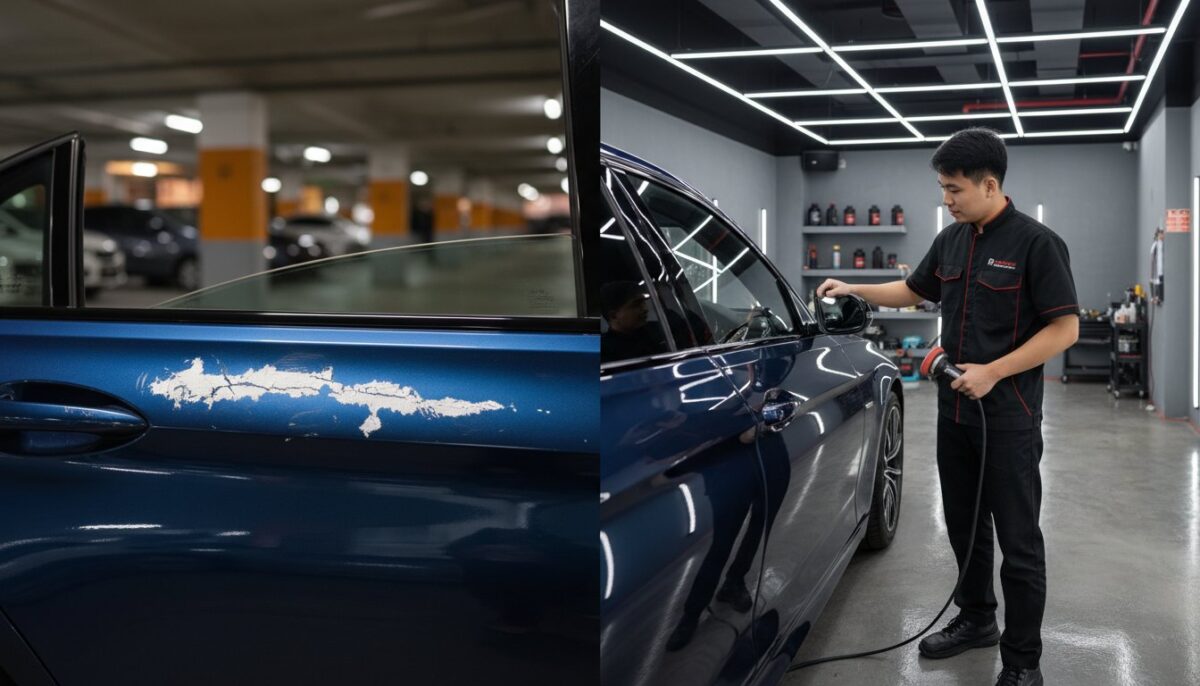
That S$20 “miracle” tube you found online isn’t repairing your paint; it’s likely hiding the damage with temporary oils that vanish after a single afternoon rainstorm. Most car owners in Singapore waste hundreds of dollars on retail products before realizing they need a car scratch remover that actually works rather than a temporary mask. We understand the stress of seeing a fresh blemish on your vehicle and the fear that a DIY mistake might plummet its resale value. It’s frustrating to deal with “disappearing” fixes that leave your car looking worse than before.
You deserve a pristine, showroom-shine finish that lasts for years, not just until your next trip to the car wash. This guide reveals the truth about permanent paint correction and when you should put down the abrasive compound to avoid burning through your clear coat. You’ll learn how to identify different types of paint damage and which professional-grade solutions are safe for your specific car paint. We’ll help you decide if a quick home fix is possible or if it’s time to consult the specialists to ensure your car’s exterior remains meticulously preserved.
Key Takeaways
- Understand the three-layer anatomy of your paintwork to distinguish between minor clear coat scuffs and deep damage that requires professional restoration.
- Learn how to identify a car scratch remover that actually works for surface-level imperfections while avoiding “filler” products that offer only temporary results.
- Discover how Singapore’s intense UV index and high humidity can cause DIY touch-ups to oxidize and fail, potentially devaluing your vehicle.
- Master the professional “Fingernail Test” to instantly determine if a scratch is a safe DIY project or if it necessitates expert paint correction.
- Explore the meticulous difference between standard buffing and Revol’s specialized detailing process to achieve a permanent, showroom-shine condition.
Does it Actually Work? The Science of Car Scratch Removal
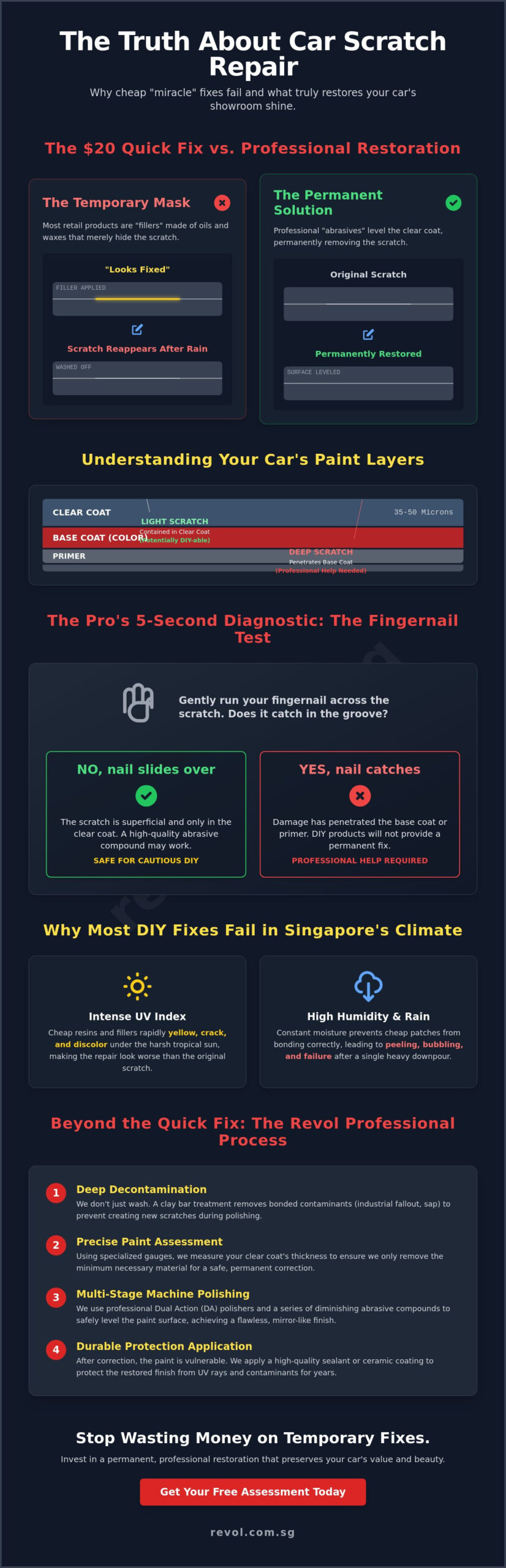
A car scratch remover that actually works isn’t a miracle cure; it’s a specific chemical or abrasive agent engineered to either level the clear coat or fill a physical void. Most Singaporean car owners feel frustrated when a DIY product fails after the first heavy downpour. This happens because many drivers don’t understand the underlying structure of their vehicle’s finish. To get results, you must understand The Science of Car Paint, which consists of three distinct layers: the primer, the base coat (color), and the clear coat.
The clear coat is your car’s first line of defense, typically measuring between 35 to 50 microns in thickness. When you see a scratch, you’re looking at a valley in this transparent layer. A permanent solution involves leveling the surrounding clear coat until it matches the depth of the scratch. If the damage is deeper than the clear coat, no over-the-counter product will provide a lasting fix. True restoration requires a professional spray painting approach to replace lost pigment and protection. Most people fail because they use a “filler” when they actually need an “abrasive” to remove material.
The Fingernail Test: Your First Step
You don’t need expensive equipment to assess damage. Gently run your fingernail across the scratch. If your nail catches in the groove, the damage has penetrated the base coat or primer. At this depth, DIY bottles are useless. If your nail slides over without resistance, the scratch is superficial. These light marks are the only ones a consumer-grade car scratch remover that actually works can realistically fix by polishing the clear coat surface back to a flat, reflective state.
Abrasives vs. Fillers: Know the Difference
Success depends on choosing the right chemistry for the job. Abrasive compounds act like liquid sandpaper, microscopically shaving the clear coat to level the surface. This is a permanent fix but carries the risk of thinning the paint too much if handled poorly. Conversely, glazes and fillers use heavy oils or waxes to “hide” the scratch. While the car looks great initially, these fillers often wash off after a single car wash, revealing the original damage. Most “Scratch Repair Pens” sold in retail shops use basic clear resins that rarely bond correctly with modern factory finishes, often leading to peeling or discoloration within 60 days of application.
DIY Scratch Removers: What Actually Delivers Results?
Not every bottle on the shelf is a car scratch remover that actually works. High-quality consumer kits from brands like Meguiar’s and Chemical Guys rely on diminishing abrasive technology. These products don’t just “fill” a scratch; they level the surrounding clear coat to make the surface uniform. The Science of Scratch Removal involves using these fine abrasives to smooth out the surface until the defect is no longer visible to the eye.
Applying these compounds by hand is a common mistake that leads to inconsistent results and “haze” on the paint. A Dual Action (DA) polisher is the standard tool for 2026 DIY enthusiasts. It oscillates and rotates simultaneously, which significantly reduces the risk of burning the paint. In Singapore’s 30°C to 34°C humidity, managing surface heat is critical. You should avoid “miracle” pens or “as seen on TV” solutions. These products often use cheap resins that yellow under the tropical sun and can cause permanent chemical etching on premium European finishes.
Surface preparation is the most ignored step in DIY attempts. You must perform a deep clean before any correction begins. A standard wash isn’t enough; you need a clay bar treatment to remove bonded contaminants like industrial fallout or tree sap. If you polish over these particles, you’ll effectively be sanding your car with grit, creating more damage than you started with.
Top-Rated Compounds for Light Scuffs
For faint swirl marks often seen under petrol station lights, a light finishing polish is the safest starting point. If you have isolated surface scratches that don’t catch your fingernail, move to a heavier compound. It’s vital to remember that these abrasives strip away protection. You must follow up with a high-quality sealant or wax to prevent oxidation. For those who want a lasting result without the effort, professional car grooming provides a level of precision that hand-application can’t match.
The Danger of ‘Over-Polishing’
Your car’s clear coat is thinner than you think. Most modern factory paint jobs have a clear coat layer between 35 and 50 microns thick. A standard Post-it note is approximately 100 microns, meaning your entire protective layer is less than half the thickness of a small piece of paper. Every DIY attempt removes a few microns of this finish. Strike-through is the point where the base coat is exposed, requiring a full respray. Once you’ve reached the pigment, no amount of car scratch remover that actually works will save the panel.
Why Most DIY Fixes Fail in Singapore’s Climate
Singapore’s tropical environment is arguably the harshest testing ground for any automotive finish. While a generic car scratch remover that actually works in temperate Europe might provide a temporary fix, it often fails within days under our local conditions. The combination of intense heat, extreme humidity, and industrial pollutants creates a chemical cocktail that aggressively attacks DIY repairs. Most off-the-shelf products are designed for DIY enthusiasts in cooler climates where surface temperatures rarely exceed 40°C. In Singapore, a car parked at an open-air HDB carpark can see panel temperatures soar to 70°C by noon.
UV Degradation and DIY Fillers
Most retail scratch kits rely on heavy silicone or wax-based fillers to mask imperfections. These substances have low melting points. When the Singapore sun hits your car with a UV index that frequently reaches 11 or higher, these fillers liquefy and evaporate. This leads to the “ghosting” effect, where a scratch you thought was gone reappears after just one week of outdoor parking. You can see how our ZeTough 9H Ceramic Coating provides superior UV protection by creating a permanent bond that doesn’t melt away like cheap retail waxes.
- Thermal Expansion: Constant cycling between 32°C daytime heat and sudden tropical downpours causes the metal panels to expand and contract, cracking brittle DIY touch-up paints.
- Oxidation Acceleration: High heat speeds up the chemical reaction between oxygen and exposed metal, turning a minor scratch into a rust spot faster than you’d expect.
- Hologramming: Without professional high-torque rotary polishers, DIY attempts often leave “cloudy” or “hazy” marks that become painfully visible under the bright midday sun.
The Tropical Oxidation Problem
Humidity in Singapore averages around 84%, which is a nightmare for paint curing. When you apply a DIY touch-up pen in your driveway, moisture becomes trapped beneath the wet paint layer. As the car heats up, this moisture tries to escape, leading to tiny bubbles or a “milky” finish that ruins the aesthetic. Achieving a “showroom shine” requires the controlled environment of professional-grade booths where humidity and dust are strictly managed. For those dealing with deeper damage that DIY kits can’t touch, our professional spray painting services ensure a seamless, moisture-free bond.
Owners also frequently mistake “acid rain” etching for deep scratches. Singapore’s rain often carries industrial particulates that sit on the surface. When the water evaporates in the heat, it leaves behind concentrated mineral rings that eat into the clear coat. Using a car scratch remover that actually works on mechanical scratches won’t solve this chemical etching. In fact, aggressive scrubbing with the wrong DIY compound often thins the clear coat further, making the car even more vulnerable to future water spotting. Professional intervention is the only way to level the paint surface without compromising its structural integrity.
The 4-Step Diagnostic: When to DIY vs. Call a Professional
Finding a car scratch remover that actually works depends on your ability to read the paint damage correctly. Before you spend S$30 on a retail kit at a local hardware store, you must perform a meticulous assessment. Use this four-step diagnostic to determine if you can handle the repair in your HDB carpark or if it requires our specialized workshop equipment.
- Step 1: Deep Clean the Area. Use a pH-neutral car shampoo to remove every trace of grit and road grime. Even a single speck of dust can act like sandpaper, turning a minor scuff into a swirling mess once you start rubbing.
- Step 2: The Fingernail Test. This is the industry standard for depth assessment. Gently run your fingernail across the scratch. If your nail catches in the groove, the damage has bypassed the clear coat. In these cases, no liquid car scratch remover that actually works will magically fill that physical void.
- Step 3: Assess the Location. Scratches on plastic bumpers are primarily aesthetic concerns. However, scratches on metal panels, such as doors or the bonnet, expose the substrate to Singapore’s high humidity. Left untreated, these lead to oxidation and rust.
- Step 4: Evaluate the Paint Type. Solid colors like basic white or black are more forgiving. Metallic and pearl finishes contain tiny flakes that reflect light at specific angles. DIY “spot fixes” often leave a dull patch because the flakes don’t align with the original factory finish.
When DIY is Safe (The Green Light)
You can usually achieve a showroom-shine finish on your own if the damage is superficial. Light swirl marks, often caused by poor washing techniques at automated stations, respond well to high-quality polishes. Scuffs that look like “paint transfer” from another car’s bumper or a plastic pillar are also safe bets. These sit on top of your clear coat rather than cutting into it. Minor fingernail scratches tucked behind door handles are another prime candidate for a home fix.
When to Seek Professional Help (The Red Light)
If you see white, grey, or black through the scratch, you’ve reached the primer or the bare metal. These layers require professional intervention to prevent long-term structural decay. Vandalism or “key” scratches that span across multiple panels are also beyond the scope of retail bottles. These deep gouges require precision sanding and color matching that DIY kits simply cannot provide.
Metallic and pearl paints are notoriously difficult to repair at home. Because these paints are applied in multiple stages, a simple rubbing compound will often strip the “flip” effect of the paint, leaving a visible dark spot. For these complex finishes, it’s safer to learn about our Paintwork & Respray services for deep damage. Our team has maintained a record of excellence since 2003, ensuring your car returns to a pristine, factory-grade appearance.
Don’t risk a DIY mistake that costs more to fix later. Book a professional paint assessment with Revol Carz today and restore your vehicle’s value.
Beyond the Quick Fix: Professional Restoration and Protection
DIY solutions often act as a temporary mask. Most retail products use heavy fillers and oils that disappear after a few washes in Singapore’s frequent rain. If you want a car scratch remover that actually works over the long term, professional restoration is the only reliable path. Revol Carz approaches every vehicle with a level of precision that retail bottles cannot match. We don’t just buff your car; we execute a full paint correction that restores the surface to a pristine, showroom-shine condition.
Professional Paint Correction vs. DIY Polishing
Professional paint correction is a scientific process. Our specialists use advanced ultrasonic paint depth gauges to measure the clear coat thickness in microns before any machine touches the bodywork. This data allows us to determine exactly how much room we have to work with, ensuring we safely level the paint without compromising its integrity. While retail products offer a temporary mask, they aren’t a car scratch remover that actually works for deep defects that have penetrated the clear coat.
Our multi-stage machine polishing removes swirl marks, oxidation, and scratches permanently. We use different grades of specialized compounds and pads to refine the finish until it achieves a true mirror reflection. This meticulous attention to detail is why Revol Carz has been honored with SGCarMart’s Star Merchant Award for an unprecedented 12 years running. We provide a level of trust and consistency that a home polishing kit simply cannot replicate.
Sealing the Results with ZeTough
Once the surface is flawless, the goal shifts from restoration to long-term preservation. We seal the results with our signature ZeTough 9H Ceramic Coating. This isn’t a standard wax or sealant. It’s a permanent shield that chemically bonds to the paint, creating an ultra-hard layer that resists light scratches, bird droppings, and harsh UV rays. It is the ultimate preventative car scratch remover that actually works by stopping damage before it reaches your paintwork.
A professional finish lasts for years, not weeks. While a DIY polish might look good for a month, the ZeTough coating maintains a deep, hydrophobic gloss that makes maintenance effortless. It ensures your car remains smooth and protected regardless of Singapore’s intense tropical humidity and heat. Take the first step toward a permanent solution for your vehicle’s appearance.
Book a professional paint assessment at Revol Carz today and let our experts restore your car to its original glory.
Give Your Vehicle the Permanent Protection It Deserves
Finding a car scratch remover that actually works requires more than a quick fix from a retail shelf. While DIY kits might mask minor surface scuffs, they often fail to address deep clear coat damage, especially under Singapore’s punishing tropical sun and high humidity. Professional restoration provides a level of precision that retail products can’t replicate. By choosing a specialized service, you’re investing in a finish that stays brilliant for years rather than weeks.
Revol Carz brings unparalleled expertise to every job as the winner of the SGCarMart Star Merchant Award for 12 years running. With over 5,000 5-star customer reviews, our specialists use proprietary ZeTough 9H Ceramic Coating Technology to shield your paintwork meticulously. We don’t just hide imperfections; we restore your car to a pristine, showroom-shine condition that stands the test of time. Trust the experts who’ve been serving Singaporean drivers since 2003.
Restore your car’s flawless finish with Singapore’s leading specialists: Book Now!
We look forward to helping you regain that pride of ownership today.
Frequently Asked Questions
Do car scratch remover pens actually work for deep scratches?
Car scratch remover pens don’t work for deep scratches that penetrate the primer or reach the metal. These pens typically contain a clear resin that fills shallow surface marks, but they lack the pigment and thickness required for structural paint damage. For 95% of deep gouges, a professional respray or touch-up is the only car scratch remover that actually works to restore the factory finish.
Can toothpaste really remove scratches from car paint?
Toothpaste can remove extremely light surface hazing because it contains mild abrasives similar to polishing compounds. However, it’s not a reliable solution for actual scratches. Most toothpastes have an RDA value between 70 and 250, which is inconsistent for automotive clear coats. Using the wrong grit can leave your paint looking dull or cloudy, requiring professional correction to fix the haze.
What is the difference between a car polish and a scratch remover?
Car polish is designed to enhance gloss and remove microscopic oxidation, while a scratch remover contains heavier abrasives to level the surrounding clear coat. Polishes generally have a finer grit to create a mirror-like reflection. In contrast, scratch removers focus on cutting the paint surface to eliminate visible grooves. A professional car scratch remover that actually works must be followed by a fine polish to restore the shine.
How much does it cost for a professional to buff out a scratch in Singapore?
Professional buffing costs in Singapore typically range from S$80 to S$250 per panel depending on the severity of the damage. According to 2024 market surveys of reputable workshops, a full machine polish and paint correction service for a standard sedan can start from S$300. These prices reflect the specialized equipment and labor required to achieve a showroom-shine condition without damaging the delicate paint layers.
Will a scratch remover ruin my car’s clear coat if I use it too much?
Yes, overusing scratch removers will eventually strip away your car’s clear coat. A factory clear coat is usually only 35 to 50 microns thick, which is thinner than a post-it note. Every time you use an abrasive product, you remove a few microns. Once the clear coat is gone, your paint will oxidize and peel. This leads to permanent damage that requires an expensive respray.
Can I use a scratch remover on a ceramic-coated car?
You shouldn’t use traditional scratch removers on a ceramic-coated car because the abrasives will instantly strip the protective layer. Ceramic coatings like ZeTough create a semi-permanent bond that is harder than clear coat, but scratch removers are designed to level surfaces by friction. If your coated car has a scratch, it’s best to consult a specialist to determine if the mark is in the coating or the paint.
Why does my scratch come back after I wash the car?
Scratches often reappear because many retail products use heavy oils or waxes to hide the mark rather than removing it. When you wash your car with high-pressure water or degreasing soaps, these temporary fillers are stripped away. This reveals the original groove that was never actually leveled. True paint correction involves physically smoothing the clear coat, ensuring the scratch is gone for good rather than just masked.
Is it worth fixing a small scratch before selling my car in Singapore?
Fixing visible scratches is highly beneficial for resale value in the Singapore used car market. Data from local automotive portals suggests that a car in pristine appearance can command a premium of S$2,000 to S$5,000 over a similar model with visible wear. First impressions are critical for buyers. A well-maintained exterior signals that the mechanical components were likely treated with the same meticulous care by the owner.

